Accurate loading, effective fibre processing and a consistent mix are key to getting the most from every ration. Discover how Abbey Diet Feeders can support efficient feeding, consistent TMR mixing and dairy herd performance.

Search...
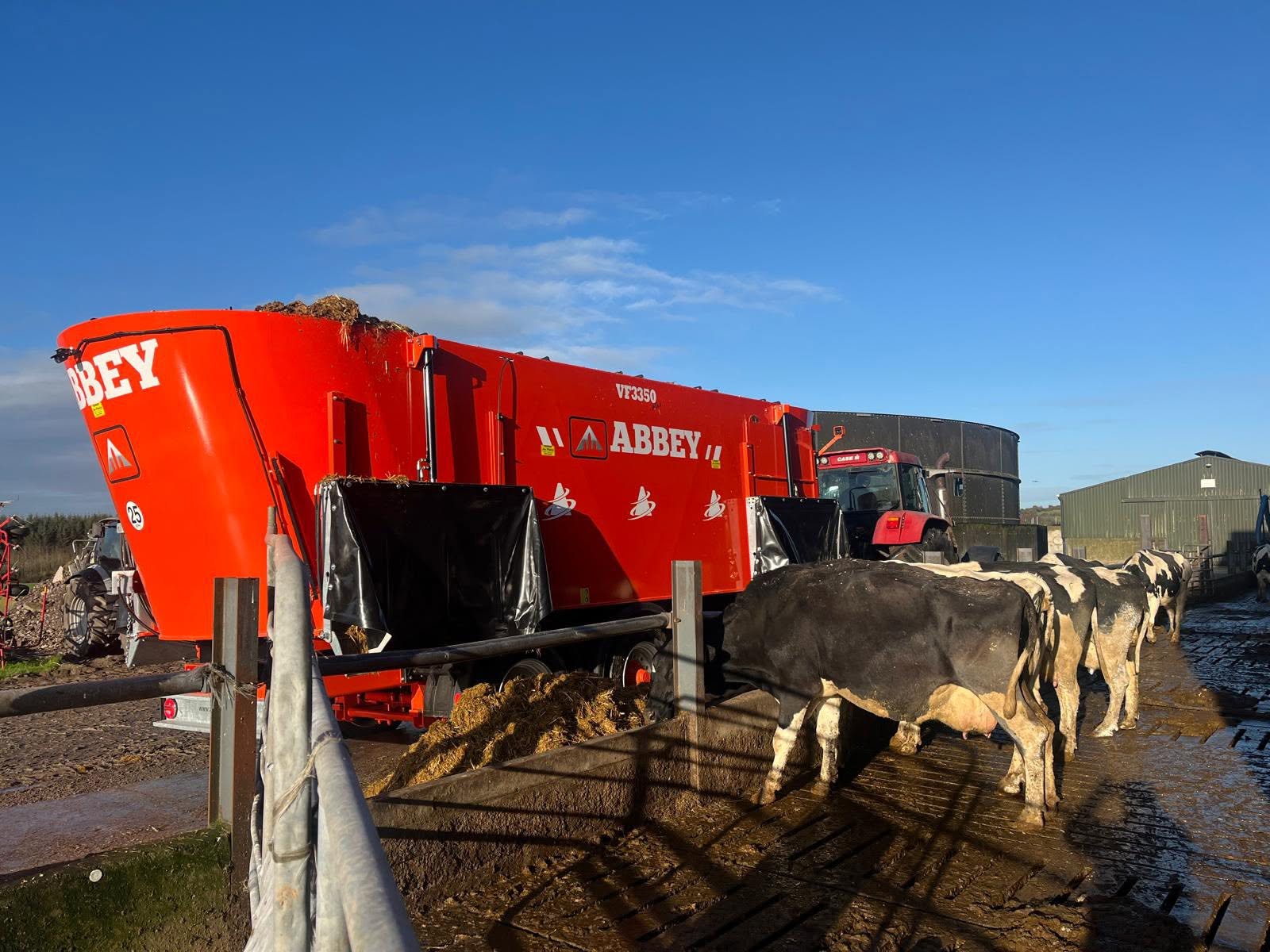
Accurate loading, effective fibre processing and a uniform mix can help dairy farmers protect herd performance as they transition towards winter feeding.
Even a well-formulated ration can underperform if ingredients are weighed inaccurately, mixed inconsistently or presented in a way that allows cows to sort at the feed face. With feed representing one of the largest costs on a dairy farm, consistency matters at every stage, from assessing forage and setting the ration to loading, mixing and delivering feed along the full length of the barrier.
A Total Mixed Ration (TMR) or partial mixed ration brings forage, concentrates, minerals and fibre together so that each mouthful is as uniform as possible. This is particularly important when variations in grass supply, silage dry matter, forage quality or cow demand create a potential energy gap.
Consistency begins at loading
Regular forage analysis and routine dry-matter checks provide the foundation for accurate ration formulation. The ration should be reviewed with a qualified nutrition adviser whenever forage stocks, grazing conditions, cow numbers or production targets change.
Loading order, knife configuration, mixing time and machine fill level all influence the finished ration. The objective is a homogeneous mix with sufficient physically effective fibre to support rumination, without overprocessing the ration or allowing ingredients to separate during feed-out.
Abbey recommends loading long-fibre ingredients first, followed by cereal forages, concentrate blends, micro-ingredients, moist feeds and grass silage. This gives fibrous ingredients time to process while helping smaller components become evenly distributed throughout the ration. The precise sequence should be adapted to the ingredients, moisture levels and advice of the farm’s nutritionist.
Engineered for an even mix
Abbey Machinery’s single, twin and tri-auger Diet Feeders are designed to deliver repeatable mixing, accurate weighing and efficient feed-out.
The rolled tub and low-profile auger geometry promote the movement of material throughout the feeder. An inflected top knife assists with bale processing, while adjustable knives and extended counter-knives allow the machine to be configured for different forage types and ration structures.
The range can process grass and maize silage, straw, wholecrop, grain, vegetables, moist feeds and blended rations. Heavy-duty 22mm auger construction and Hardox wear-protection options are also available for farms working with abrasive ingredients or operating at high annual tonnages.
A door wedge and generous feed-out opening help material move freely during discharge. Farmers can choose from different door positions, elevator options and conveyor arrangements, such as sliding flat conveyors and raising cross conveyors, to suit narrow passages, raised troughs and individual yard layouts.
This flexibility allows the feeder to be specified around herd size, ration density, loading equipment, feed-passage dimensions and daily workload.
Wiltshire dairy farmer Dan Jackson highlighted the importance of retaining the correct ration structure:
“You can see it cuts the silage to a shorter length, but not so short that there is no fibre left. It is nicely mixed and nicely processed.”
From the planned ration to the ration delivered
Integrated weighing helps operators load ingredients accurately and allocate the correct quantity of feed to each group. Abbey’s TMR Tracker system adds another level of control by comparing the intended ration with what is actually loaded and delivered.
Ration information can be transferred between the farm computer and the Diet Feeder, while ingredient weights and feeding records are returned for review. The system can record dry-matter intake and daily feed costs, highlight differences between operators and support feed-stock management.
This provides farmers and nutrition advisers with a clearer picture of feeding performance and can help identify unnecessary overfeeding or variation between loads.
The Johnston family use an Abbey VF3050 with TMR Tracker on their 500-cow dairy unit in Cumbria. The system allows them to monitor the weight of each ingredient, compare the planned and delivered ration, and record daily feed costs and dry-matter intake. It also provides a record of who completed each feed and when, helping the farm maintain consistency between operators and loads.
Let the feed face provide feedback
The effectiveness of the ration should continue to be assessed after feed-out. Sorting, uneven particle distribution, heating, refusals and differences in intake along the barrier can all indicate that adjustments are required.
Rumination, body condition, rumen fill, manure consistency, milk yield and milk constituents also provide useful signals about how well the ration is being consumed and utilised. Reviewing these indicators alongside dry-matter intake can help farmers identify changes before they develop into more significant performance issues.
Prepare before feeding intensifies
Before winter feeding begins, operators should inspect augers, knives and counter-knives for wear and check the weighing system and display. The driveline, gearbox oil, tyres, brakes, lighting, discharge doors and conveyors should also be examined.
Completing routine maintenance before workloads increase can reduce the risk of downtime during the busiest part of the feeding season.
Precision feeding is ultimately a repeatable process combining reliable forage information, sound nutritional advice, accurate weighing, effective processing and close observation of the herd. With the right machine specification and consistent daily management, an Abbey Diet Feeder can help farmers use feed effectively while supporting rumen health, production and margins throughout the feeding season.
View the full Abbey Machinery Diet Feeder Range Here.
References
Brady, E.L., Pierce, K.M., Lynch, M.B., Fahey, A.G. and Mulligan, F.J. (2021). The effect of nutritional management in early lactation and dairy cow genotype on milk production, metabolic status, and uterine recovery in a pasture-based system. Journal of Dairy Science, 104(5), 5522–5538. https://doi.org/10.3168/jds.2020-19329
Butler, M., Patton, J., Mulligan, F.J. and Murphy, J.J. (2009). Comparison of milk production performance of Holstein Friesian cows managed under pasture or partial mixed ration feeding systems. Agricultural Research Forum, Tullamore, 12 March 2009, p. 25.
McAuliffe, S., Gilliland, T., Egan, M. and Hennessy, D. (2016). Comparison of pasture-based feeding systems and a total mixed ration feeding system on dairy cow milk production. Proceedings of the 26th General Meeting of the European Grassland Federation, Trondheim, Norway, pp. 376–378.
Subscribe to our Newsletter!
Stay ahead with Abbey Machinery! Subscribe to our newsletter for the latest updates and tips, right in your inbox.

Products
Copyright © 2024 Abbey Machinery | All Rights Reserved | Designed & Developed by The Smart Group